The Ehsaas Rashan Program 8123 is a Pakistani government food subsidy initiative designed to help low-income families afford essential groceries. Through a dedicated web portal and a simple SMS system, eligible citizens can register and access discounts of up to 30% on staple items like flour, sugar, and cooking oil.
Pakistan's social protection landscape has expanded significantly in recent years, and the Ehsaas Rashan Program stands as one of its most practical expressions. Rather than cash transfers alone, it targets the grocery bill directly — the place where inflation hits hardest for vulnerable households. The program operates under the broader Ehsaas Initiative, a government-led umbrella of welfare schemes, and connects to national identity databases to verify eligibility and prevent misuse.
The dual-access model — web portal and SMS code 8123 — reflects a deliberate effort to reach both urban and rural populations across Pakistan. Whether someone has a smartphone with internet access or only a basic mobile phone, the system accommodates both realities.
Ehsaas Rashan Program 8123: what the subsidy actually covers
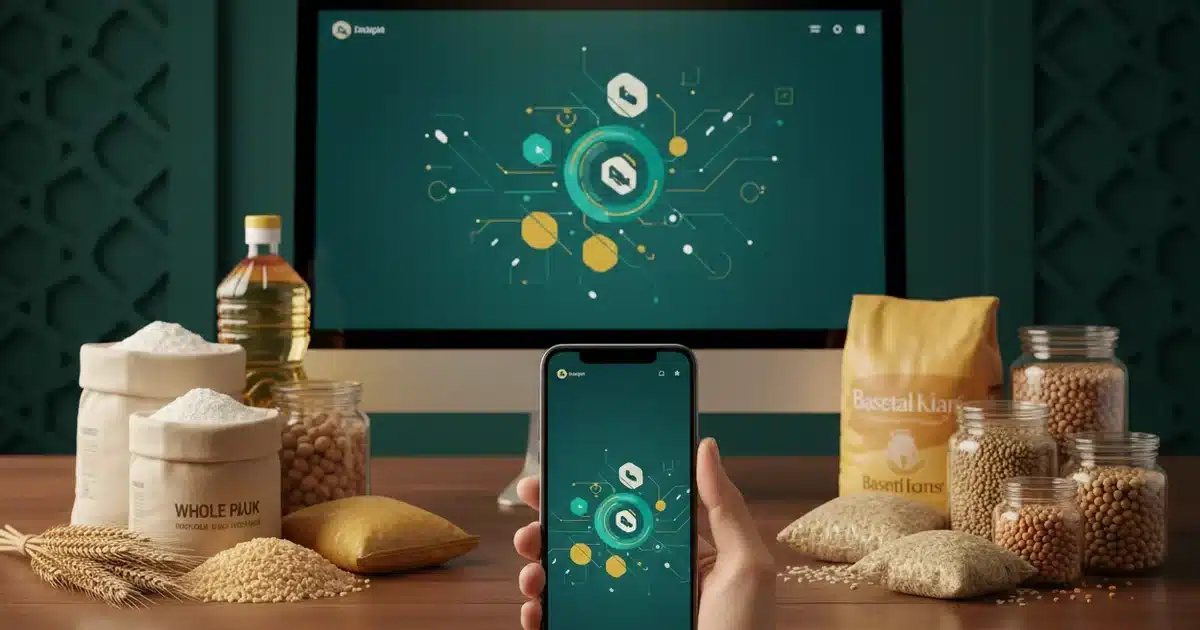
The program focuses on a defined basket of food staples. These are not luxury goods — they are the foundation of the Pakistani household diet, and precisely the products most exposed to price volatility.
Subsidized items include:
- Wheat flour
- Sugar
- Pulses (lentils and similar legumes)
- Cooking oil
- Rice
The discount applied to these products reaches up to 30%, which translates into a meaningful reduction in monthly grocery spending for eligible families. For a household already stretched thin, that margin matters. Purchases are made through registered utility stores and authorized partner retailers, ensuring the subsidy flows through a controlled distribution network rather than open markets where verification would be impossible.
maximum discount on essential food items for eligible Ehsaas Rashan beneficiaries
The geographic reach of the program spans numerous regions across Pakistan, covering both cities and rural areas. Punjab is specifically referenced in the context of the Ramzan Package 2026, a seasonal extension of food assistance tied to the same infrastructure.
How eligibility is determined for the food subsidy program
Eligibility rests on a few clear criteria. Applicants must be Pakistani citizens holding a valid CNIC (Computerized National Identity Card). Their monthly household income must fall below the threshold defined by the government for low-income classification. Families already enrolled in other government welfare programs — such as BISP (Benazir Income Support Programme) — may receive priority consideration.
One category is explicitly excluded: high-salary government employees. The program is designed for economic vulnerability, not public sector affiliation. Verification runs through official national databases, which cross-reference identity and income data to confirm eligibility automatically. This database-driven approach also serves as the primary fraud prevention mechanism.
Eligibility verification is handled automatically via national identity databases linked to the CNIC. Applicants do not need to submit paper documents — the system cross-checks data in the background.
How to apply through the 8123 web portal and SMS system
The Ehsaas Rashan Program offers two registration paths. Both require nothing more than a valid CNIC number. The choice between them depends entirely on what technology is available to the applicant.
Registering via the official web portal
The web portal is the more detailed of the two methods. To apply:
- Visit the official Ehsaas Rashan web portal
- Enter your CNIC number in the designated field
- Provide the required personal information
- Submit the application form
- Wait for the system to return an eligibility confirmation
The portal is designed to be accessible without technical expertise. The form structure is straightforward, and the confirmation step is automated. This method suits applicants with a smartphone or computer and a stable internet connection — a growing segment of the population, though not universal in rural Pakistan.
Registering via SMS to 8123
The SMS method is the more inclusive option, built for users without internet access. The steps are equally simple:
- Open the SMS application on any mobile phone
- Type the CNIC number without spaces
- Send the message to 8123
- Wait for the automated reply confirming eligibility status
The absence of internet dependency makes this channel particularly valuable in remote areas. A basic feature phone is sufficient. The system processes the CNIC against the national database and returns a response automatically. Pakistan's mobile penetration is broad enough that this approach meaningfully extends the program's reach beyond urban centers.
When sending your CNIC via SMS to 8123, make sure there are no spaces or dashes between the digits. The format must be continuous — for example: 3520212345678.
Checking your application status
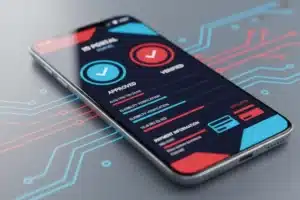
Once registered, applicants can verify their status through either channel. Via SMS, the process mirrors registration: send the CNIC number to 8123 and wait for the system's response. Via the web portal, navigate to the status verification section, enter the CNIC, click the verification option, and read the result displayed on screen. Both methods return real-time data pulled from the same national database, so the result is consistent regardless of which channel is used.
This dual-verification setup mirrors how modern digital services handle identity confirmation — not unlike the way smartphone security features increasingly rely on layered authentication systems to protect user data.
The broader social protection ecosystem this program connects to
The Ehsaas Rashan Program does not operate in isolation. It sits within a wider network of Pakistani government welfare initiatives, each targeting a different dimension of economic vulnerability.

BISP (Benazir Income Support Programme) is the most prominent parallel program. Operating under the code 8171, it delivers direct cash transfers on a quarterly basis. Phase 3 of BISP, referenced for January 2026, carries a payment of Rs. 13,500. The BISP Kafaalat component, also linked to the 8171 system, provides Rs. 15,500 per payment cycle. A separate BISP Taleemi Wazaif program addresses educational support, though specific payment amounts are not publicly detailed in the same way.
| Program | Code | Payment Amount | Frequency |
|---|---|---|---|
| BISP (Phase 3) | 8171 | Rs. 13,500 | Quarterly |
| BISP Kafaalat | 8171 | Rs. 15,500 | Quarterly |
| BISP Taleemi Wazaif | — | Not specified | — |
| Ehsaas Rashan Program | 8123 | Up to 30% discount | Ongoing |
| Ramzan Package 2026 | — | Not specified | Seasonal |
The Ramzan Package 2026 is a seasonal extension, specifically noted in the context of Punjab, where it provides additional food assistance during the holy month. These programs collectively form a layered social safety net, with cash transfers (BISP) and in-kind food subsidies (Ehsaas Rashan) working in complementary ways.
Families already enrolled in BISP may find themselves prioritized within the Ehsaas Rashan eligibility assessment, since the underlying databases are connected. This integration reduces duplication of verification efforts and speeds up access for households already confirmed as low-income. The same logic of interconnected systems appears in how governments and tech platforms increasingly share data infrastructure — a principle familiar to anyone following how data privacy in messaging platforms is evolving globally.
What the program means for food security and inflation relief in Pakistan
The practical impact of the Ehsaas Rashan Program is measurable at the household level. A 30% reduction on wheat flour, sugar, pulses, cooking oil, and rice directly lowers the monthly grocery bill for families who spend a disproportionate share of their income on food. But the program's significance extends beyond individual households.
At a national scale, the initiative addresses food insecurity in a country where inflation on essential goods has repeatedly strained household budgets in recent years. By locking in subsidized prices at registered utility stores and partner retailers, the government creates a buffer between volatile market prices and the most vulnerable consumers. The subsidy does not eliminate inflation, but it insulates a defined population from its worst effects.
The fraud prevention mechanism built into the system adds a layer of institutional credibility. Because eligibility is verified through national identity databases rather than self-declaration, the risk of misappropriation is structurally reduced. High-salary government employees cannot claim benefits they are not entitled to — the database cross-check catches the discrepancy before any subsidy is issued.
And the digital access model, combining the 8123 web portal with SMS registration, reflects a broader shift in how social protection is administered in Pakistan. Programs that once required physical visits to government offices now operate through mobile phones and internet connections, reducing barriers for the populations they are designed to serve. January 2026 and February 2026 references in program documentation suggest active expansion and payment cycles continuing into the near term, with the Ramzan Package 2026 indicating seasonal scaling as well.
The Ehsaas Rashan Program, in this sense, is not just a food subsidy. It is a demonstration of what targeted, database-driven, digitally accessible welfare can look like when the infrastructure is built to reach people where they are.