
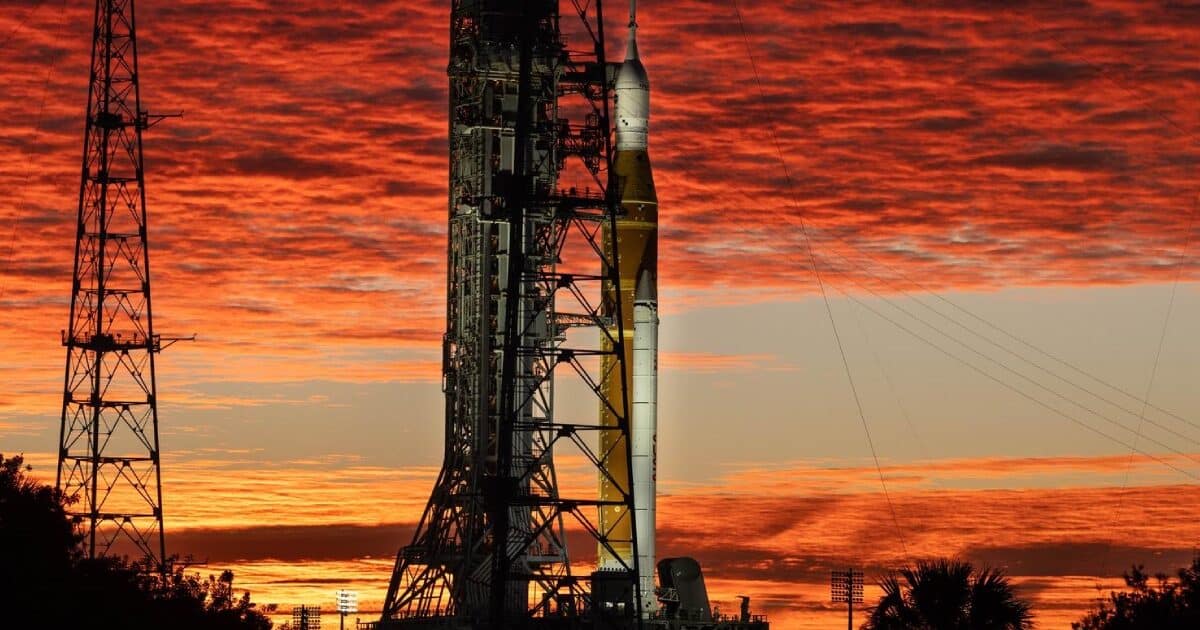
NASA cannot yet quantify the risks of the Artemis 2 mission — the agency refuses to publish any precise probability figures for a crewed lunar flyby that would be humanity's first deep-space journey since 1972. With only one SLS flight on record, hydrogen leaks already disrupting the schedule, and peak solar activity threatening radiation exposure, the unknowns are simply too numerous to reduce to a single number.
The Artemis 2 mission carries four astronauts on a roughly ten-day journey around the Moon. It sounds straightforward enough, but beneath the surface of that description lies a tangle of technical and environmental uncertainties that NASA's own program managers struggle to frame in quantitative terms. And that struggle is not a communication failure. It is an honest reflection of where the program actually stands.
The last time humans traveled beyond low Earth orbit was during the Apollo 17 mission in 1972, more than 54 years ago. Artemis 2 does not just represent a return to deep space. It represents a complete restart, with new hardware, new systems, and a gap in operational knowledge that no amount of simulation can fully close.
NASA's inability to quantify Artemis 2 risk starts with the SLS record
The Space Launch System (SLS) has flown exactly once. Artemis 1, the uncrewed test flight in 2022, demonstrated that the rocket could reach deep space, but a single successful flight is a thin statistical foundation. Program managers themselves have acknowledged that historically, new launch vehicles succeed on their first attempt roughly 50% of the time. The target reliability standard for crewed missions, by contrast, sits around a 1-in-50 failure rate, or approximately 2%.
The gap between those two numbers tells the story. Moving from a coin-flip probability to a near-certain outcome requires a sustained launch cadence, repeated missions, and accumulated data across multiple flight profiles. The Artemis program has none of that yet. More than three years separate Artemis 1 from Artemis 2, an interval that reflects both the complexity of the hardware and the disruptions caused by technical problems along the way.
Hydrogen leaks and schedule revisions
Among those problems, hydrogen leaks detected during ground testing of the SLS stand out. Hydrogen is the primary fuel for the rocket's core stage engines, and managing it at cryogenic temperatures is notoriously difficult. These leaks forced NASA to revise its planning timeline, adding delay to a program that was already operating under significant pressure. Each revision is not just a scheduling inconvenience. It is a reminder that the vehicle's behavior under operational conditions remains partially unpredictable.
Historically, major accidents in crewed spaceflight have occurred predominantly during two mission phases: launch and atmospheric reentry. Both phases are present in the Artemis 2 mission profile.
The space environment adds threats that no engineering can fully control
Beyond the rocket itself, the environment through which Artemis 2 will travel introduces hazards that are difficult to model and impossible to eliminate. Micrometeorites and orbital debris represent a constant background threat to any spacecraft operating beyond Earth's atmosphere. The probability of a damaging impact during a ten-day mission is low, but it is not zero, and it cannot be precisely calculated without extensive flight history in similar trajectories.
Solar activity and radiation exposure
The timing of Artemis 2 adds another layer of complexity. Solar activity is currently running at elevated levels, which means the four crew members face a higher potential exposure to solar radiation than they would during a quieter phase of the solar cycle. Solar flares and coronal mass ejections can deliver intense bursts of energetic particles with very little warning. Spacecraft shielding provides some protection, but deep-space missions lack the magnetic field buffer that partially shields astronauts aboard the International Space Station.
since the last crewed deep-space mission, making Artemis 2 a near-total restart in operational terms
Résultat: NASA cannot simply run a risk model against historical data for this radiation environment, because there is no historical data for crewed lunar-vicinity missions during the current solar cycle. The agency can estimate ranges, but a precise figure would carry false confidence.
Artemis 2 must validate critical systems before any lunar landing attempt
The mission's purpose goes beyond sending humans around the Moon. Artemis 2 serves as a validation flight for systems that will be needed for a future lunar landing, including life support, navigation, communication links, and crew interfaces with the Orion spacecraft. Many of these systems have never been tested with humans aboard in deep space. Their behavior in that environment is, by definition, partially unknown until the mission actually flies.
Artemis 2 is not a landing mission. The four crew members will fly around the Moon and return to Earth, making it a critical but intermediate step in NASA’s broader return-to-the-Moon roadmap.
This is precisely why NASA refuses to publish a single probability figure for mission risk. The threats are real, they are multiple, and they interact in ways that resist clean aggregation. Micrometeorites, hydrogen system integrity, solar flare timing, launch dynamics, and reentry performance each carry their own uncertainty bands. Combining them into one number would require assumptions that the agency cannot yet justify with data.
Concrètement, the absence of a public risk figure is not evasion. It is the only intellectually honest position available to a program that is, in many meaningful ways, flying into the unknown for the first time in half a century. The data to support a confident quantitative assessment will come, but only after Artemis 2 itself provides it.